


About Routine Eye Exams at Baltimore Washington Eye Center
Routine eye exams are performed by the Ophthalmologists and Optometrists at Baltimore Washington Eye Center. Routine eye exams are recommended by the eye doctors at intervals that help to preserve eye health and vision by allowing for early detection of eye diseases, problems and conditions and treatment as necessary, as well as for providing the best eyeglass and contact lens prescriptions to see clearly.
How Often Should I Have My Eyes Examined?
The frequency of your eye examinations really depends on many factors including your age, your general health, whether your family has a history of eye problems such as glaucoma, retina problems such as macular degeneration (AMD), and whether you have been diagnosed with or treated for any eye conditions or diseases in the past. This information will be used by the eye doctors to determine how often to schedule an eye exam at Baltimore Washington Eye Center, as well as what type of examination and testing is necessary.
What Will Happen At My Eye Examination?
If you are scheduling a general eye examination at Baltimore Washington Eye Center, it will consist of complete testing of your vision in order to be certain that you are seeing as clearly as you should, as well as a comprehensive medical evaluation of the health of your eyes. Each patient visiting us for a complete eye exam will have the necessary testing to ensure that their eye health and vision are at their best.
Your Health and Eye History
A complete history will be taken from you regarding your general health, any previous eye problems or conditions that you have experienced and a review of any problems that you might be experiencing with your vision or your eyes. This will be important information to provide to the technician or eye doctor during your screening process. If you have any chronic health problems, even if they are currently stable, it is important that you share this information as well.
Please be sure to tell the technician or eye doctor about any medications you are taking for these medical conditions, including over the counter medications or eye drops that you may have been using. They are all important. Please bring a current list of medications, if you have one.
Your family history will be reviewed with you as well. Please tell us about any health problems that run in your family such as diabetes and high blood pressure, as well as any eye problems that your family members may have experienced such as glaucoma, cataracts, or macular degeneration as they can tend to run in families.
The Eye Examination Procedure
Your eye examination at Baltimore Washington Eye Center will begin with a technician measuring your vision, or visual acuity, both with your current eyeglasses or contact lenses, and without any vision correction. Chances are that if you wear eyeglasses or contact lenses, some of the letters on the “Big E” eye chart will be blurry without them. The technician will ask you to read a chart that consists of numbers and letters that get progressively smaller and more difficult to read as you move down the chart. This test, called “Snellen Acuity” or just “Visual Acuity” is an important first step to understanding how well you see.
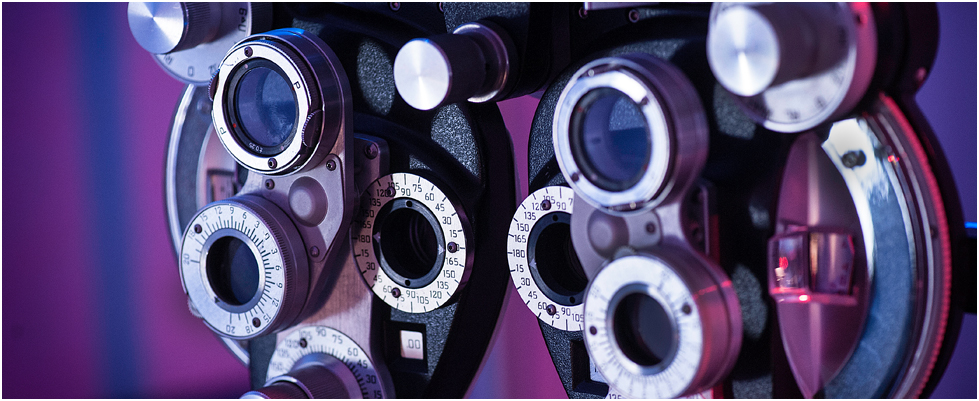
Your eye doctor will then check your refraction in order to determine the most accurate eyeglass or contact lens prescription necessary to fully correct your vision. This entails having you sit behind an instrument called a Phoroptor, so that the doctor can present a number of lens combinations to see which corrects your vision most precisely. For those patients who wear eyeglasses or contact lenses, you have probably experienced the “which is better” test called refraction. If you require vision correction, the eye doctor will provide you with a copy of your prescription so that you can take it to the eyeglass and optical shop at Baltimore Washington Eye Center Optical Department where our Opticians can help you select the best fitting and fashionable frame and the most appropriate type of lenses for your work, hobbies or daily activities.
Next, the movement of your eyes, or “Ocular Motility” will be evaluated in order to understand how well the eye muscles function together and how effectively they move your eyes into the different positions of gaze.
By shining a fairly bright light in your eyes, the reaction of your pupils to the light will be evaluated. By shining the light into your eyes in different directions, the doctors can learn a great deal about how well your optic nerve is functioning.
In order to check for one of the signs of glaucoma, 1-2 eye drops will be placed in your eyes so that the pressure, called Intraocular Pressure (IOP), can be measured while you are behind the Slit Lamp, or with a Tono Pen, which is a handheld instrument. This is an important diagnostic test for glaucoma.
At this time, additional eye drops will be placed in your eyes in order to dilate or widen your pupils. Pupil dilation is important so that the doctor can examine the health of the structures in the back of your eye including the retina and its blood vessels and the optic nerve. After the dilation drops are placed in your eyes, it will usually take anywhere from 15 to 30 minutes for the eye drops to fully work and dilate your pupil. Please be patient. You will be asked to relax in one of our comfortable waiting areas while the eye drops work, or if you prefer, you may browse our optical shop while you wait.
The thorough examination of the health of the retina and optic nerve through a dilated pupil is not uncomfortable; ever the fully widened pupil may make you somewhat sensitive to light and may also blur your vision, especially at near, for a few hours after your eye examination. If you have not had a dilated exam in the past, it is a good idea to have a driver with you on your exam day. It is important to bring a good pair of sunglasses with you in order to lessen your light sensitivity.
Once your pupils have dilated, you will be asked to sit comfortably behind a specialized instrument called a Slit Lamp Biomicroscope. This instrument provides the eye doctor with both high magnification and special illumination. Using this instrument it is possible for Baltimore Washington Eye Center Ophthalmologist or Optometrist to examine the condition of your eyelids, eye lashes, eyelid margins and tear film. The Slit Lamp will also be used to carefully examine the sclera or white of your eye, and the cornea or clear dome-shaped lens, on the outside of your eye. By focusing the slit lamp through the pupil, or dark center of the iris, or colored part of the eye, your doctor will be able to examine the health of the crystalline lens, which is where cataracts form. Lastly, the retina and the optic nerve are examined.
Patients needing an eye exam in the greater Baltimore or Washington, D.C area are encouraged to call us at 800-495-3937 to schedule an appointment.
Eye Problems
Cataracts
Cornea Problems
Diabetic Retinopathy
Dry Eye
Glaucoma
Macular Degeneration
Eye Conditions
Eye Exams at Baltimore Washington Eye Center in Glen Burnie Maryland.
Contact Us
200 Hospital Drive
Suite 600
Glen Burnie, Maryland 21061
P / 410-766-3937
F / 410-766-2904
©2020 Baltimore Washington Eye Center
Baltimore Washington Eye Center provides quality ophthalmology services including laser assisted eye surgery such laser cataract surgery, advanced technology lens implants (IOL), diagnosis & treatment of glaucoma, macular degeneration, diabetic retinopathy & dry eye, as well as eye exams for cataracts, eyeglasses and contact lenses.